The Automated Ball-Strike challenge system is the biggest rule change heading into the 2026 season. Players can now challenge called balls and strikes, with a robot umpire reviewing the call. The system has been running in spring training since February 20.
We downloaded pitch-level Statcast data for every spring training game played between February 20 and March 3 -- 49,510 pitches across 162 games and 12 days -- and searched for ABS challenge outcomes in the play-by-play descriptions.
The Headline Number
We found 185 total ABS challenges in the data. Of those, 180 had clear outcomes -- the original call was either confirmed or overturned. Five had ambiguous play-by-play text that didn't explicitly state an outcome.
Of the 180 decided challenges, umpires were confirmed correct 100 times and overturned 80 times. That's an overturn rate of 44.4%. Nearly half the time a player challenges a call, the umpire got it wrong.
Strikes vs Balls
Challenges skewed heavily toward called third strikes. Of the 185 challenges, 134 came on called strikes and 51 on called balls -- a 2.6-to-1 ratio.
This makes intuitive sense. A called third strike ends a plate appearance. A called ball four does too, but in the hitter's favor -- meaning it's the defensive side (typically the catcher) initiating the challenge. Batters facing elimination on a borderline pitch have a stronger incentive to challenge than catchers defending a walk.
Overturn rates were similar for both call types:
| Original Call | Challenges | Decided | Overturned | Overturn Rate |
|---|---|---|---|---|
| Called strike | 134 | 131 | 57 | 43.5% |
| Called ball | 51 | 49 | 23 | 46.9% |
The slightly higher overturn rate on ball challenges (46.9% vs 43.5%) is interesting but the sample is small -- 49 decided ball challenges isn't enough to draw a firm conclusion about a 3 percentage point difference.
Challenge Volume by Day
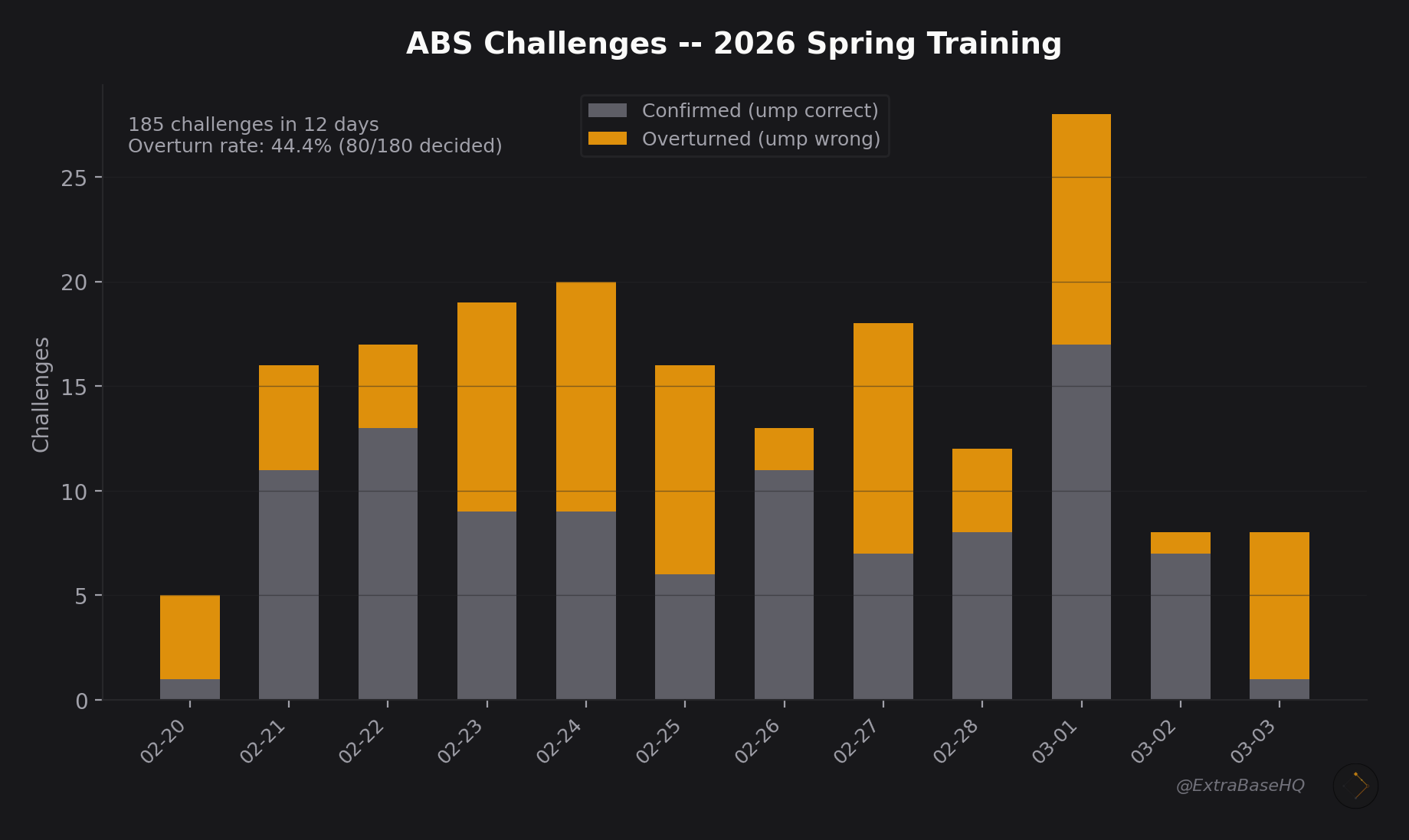
Challenge volume ranged from 5 per day (on lighter game days) to 28 on March 1. The overturn rate fluctuated significantly day-to-day -- from 12% on February 26 and March 2 to 88% on March 3 -- but this is daily noise in small samples, not a meaningful trend.
The more relevant observation is that challenge volume didn't decline over the two weeks. Players aren't getting tired of the system or running out of challenges. If anything, usage ticked up slightly in the second week.
What This Isn't
A note on what these numbers don't capture. The Statcast data also contains 94 "automatic" calls -- 79 automatic balls and 15 automatic strikes. These are pitch clock violations, not ABS challenges. An automatic ball means the pitcher didn't deliver in time; an automatic strike means the batter wasn't ready. No pitch was thrown on any of these -- they have no velocity, spin, or plate location data.
We mention this because it would be easy to conflate the two. Automatic calls and ABS challenges are different mechanisms recorded differently in the data. We're reporting only the challenge outcomes here.
Why It Matters
A 44% overturn rate tells us two things. First, players are challenging selectively -- they're not wasting challenges on pitches they know were strikes. They're picking spots where they genuinely believe the call was wrong, and they're right almost half the time.
Second, the umpire error rate on challenged pitches is substantial. These are the close pitches, the borderline calls that have always been part of the game. The ABS system is now quantifying exactly how often those calls go the wrong way.
Whether this changes anything about on-field strategy or prop market pricing is a separate question -- and one we'll be tracking as the regular season approaches.
Data source: Baseball Savant Statcast CSV export for all spring training games (game_type = "S") from February 20 to March 3, 2026. Total: 49,510 pitches across 162 games.
ABS challenges identified by searching the des (description) field for "challenged (pitch result)". Outcomes classified as "confirmed" or "overturned" based on description text. Five challenges had outcome text that didn't match either pattern and are excluded from the decided total.
Automatic balls and strikes (pitch clock violations) are recorded in the description field as "automatic_ball" and "automatic_strike" and are not included in the challenge analysis.